If you have decided to take matters into your own hands and start using Traditional Chinese Medicine for your asthma treatment then you are going to design an approach that covers many fronts. See it like a chair, it needs 4 legs to support itself. In your case, each leg is a form of treatment.
To get the most out of what TCM has to offer for asthma you need to cover Acupressure and Moxibustion, Herbal Medicine, Diet therapy, and Behavioral tools.
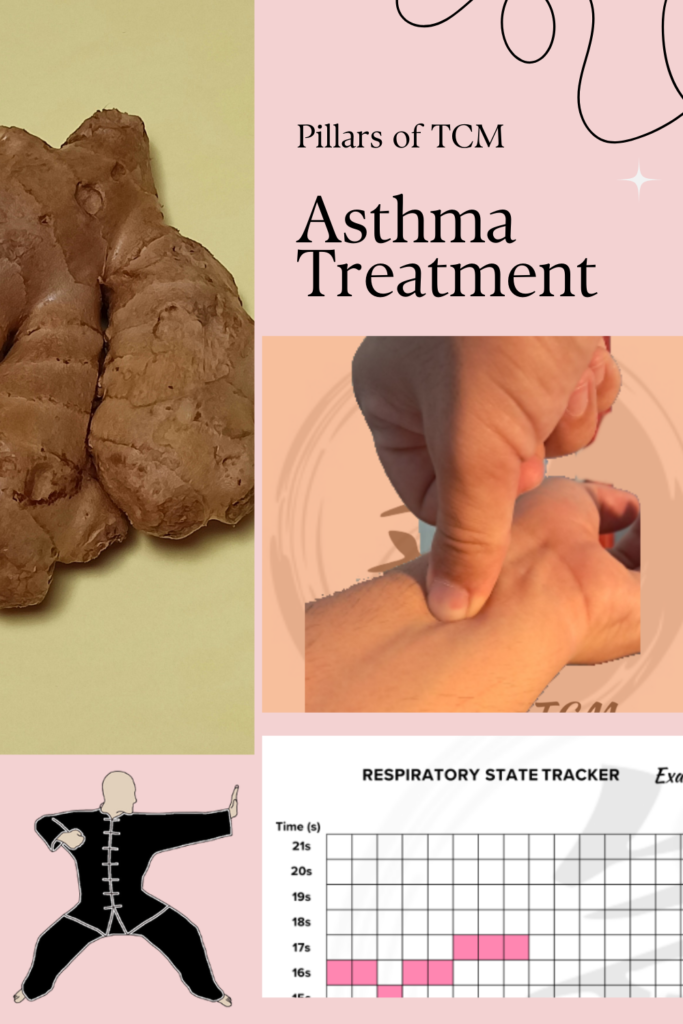
Within those behavioral tools, you will need to learn the proper way of breathing, how to use your abdomen to expel excess air in your lungs, how to check your current respiratory state, and how to keep track of it.
Today you are going to learn how to use the asthma respiratory state tracker to ensure better results when treating your asthma.
Table of Contents
What is the Respiratory State Tracker

The Respiratory State Tracker is a tool intended to be a daily record of your Lung health to assess your starting point, keep track of your progress, and analyze the effectiveness of the interventions made.
It is designed based on the need for an actionable and low-cost tool to be used daily for people with asthma as part of their holistic treatment journey.
Many people with asthma begin their day not knowing if their Lungs are especially weaker today than other days thus making them more susceptible to environmental hazards.
The Respiratory Tracker helps you by keeping track of your daily Lung health making you more aware of your inner state and allowing you to prepare accordingly.
It has an X and Y axis table where the Y represents time (you will learn in a second) and the X represents the date. And it has the Instructions and Guidelines on How to Select the Acupuncture points based on your results.
It is intended to be printed and kept in a place nearby along with the Acupoints Chart.
To get your copy of the Respiratory State Tracker along with the Asthma Relief Acupoints Chart check out my store:
How Does the Respiratory State Tracker Work
The Tracker gives you a daily real-time result of your Lung health. This of course is a rough approximation and is not intended to have the same value as other tests like spirometry. This tool is intended to make you more aware of your current Lung health so you can prepare for the day ahead.
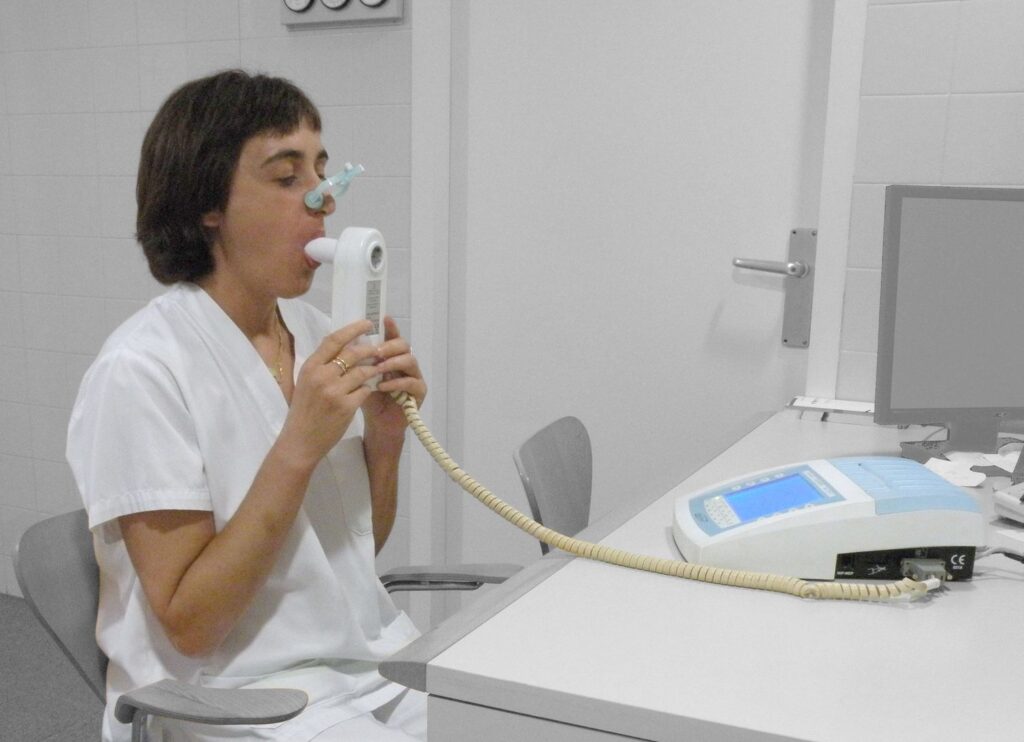
By Jmarchn – Own work, CC BY-SA 3.0, https://commons.wikimedia.org/w/index.php?curid=26590234
You will use it every day after waking up and before you get out of your house. After getting up and spending some time tuning into the day, you are going to do a breathing exercise to check your daily lung capacity.
Then you are going to mark it on the tracker and begin your Acupressure routine for asthma. The result you get will determine the behavior you are going to follow every day.
To make it clear, first, you determine your Respiratory Baseline, this is your normal lung capacity while rested, you will learn how to do it later on in the article.
This baseline is going to be the measuring stick to use from every day on.
The asthma treatment using Chinese Medicine aims to keep you level with your baseline and potentially increase your baseline number thus improving your Lung health and regressing some of that asthma.
With consistent effort and following the advice you are learning here you will be seeing results in no time.
Why Use a Respiratory State Tracker
If you are wondering why should you have to use the Tracker and not just use a sheet of paper, I’m going to give you some reasons why the State Tracker is superior to just writing it down on a piece of paper.
It’s Easy to Use and Evergreen
The simplest and first answer is that the Tracker is already made and it is easy to use. You put the results and follow the Instructions. There’s no need to reinvent the wheel, just ride.
Besides, once you get it you can print it as many times as you want and keep tracking your journey.
You skip the guessing part of what to put in your paper, how to structure it, and where to put it so you don’t throw it away without noticing. This Tracker is a printable piece to keep close to bed with the Acupoints Chart and use it every day after waking up.
Stick it to the wall or on your bedroom mirror, and take it with you on your travels.
Lost it? Just print it again and you are good to go.
You Get a Clear view of your progress.
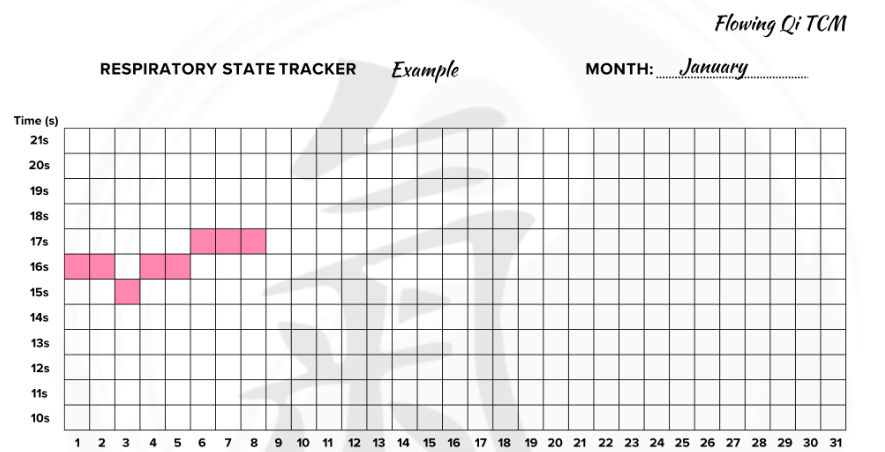
Another great reason for using the respiratory tracker is to have a clear view of your progress.
Instead of just writing down numbers on paper from Monday to Sunday, you check a box with the associated number. The compilation of data creates a trend line that better indicates the improvement you are having.
Low-cost daily check-ups.
With this tool, you won’t wait until your doctor arranges an appointment for a spirometry. You just do your version at home and keep your health in check until the next appointment.
What’s even better, this is a test you can run every day and won’t cost you a dime.
No preparation needed
Whenever you go to a doctor’s appointment and you need to get some tests done they tell you you have to prepare for it, be it fasting from the night before, avoiding certain foods, etc. In the case of the Tracker, you only need to sit still for a couple of minutes and that’s it.
Gives you a real-time result
Building up from the previous point, the tests you get done show the results of a controlled and prepared environment which is necessary for them to get the best data. This tool flips the script and focuses on whatever is your state right here and right now.
Given this is a tool intended for daily use, it is not interested in ideal conditions but rather in current conditions.
Accountability

James Clear in his book ‘Atomic Habits’ says that one of the pillars of habit-building is to make it evident, to make it so noticeable it becomes inevitable to do it.
This Tracker is meant for that.
Don’t shove it in a drawer, don’t keep it with a bunch of other papers where it will get easily confused, and place it in a place you are certain to go to or look at after waking up.
Maybe on the wall, on your bedroom mirror like I said before. Laminate it and place it like a sign on your nightstand or dresser.
The goal is to make it impossible for you to skip this routine, to keep yourself accountable.
Besides, the Tracker’s design is not that common like those artistic Etsy ones, so it will be difficult to miss if you place it in the right spot.
How to Use the Asthma Respiratory State Tracker
Now let’s get into the specifics, how to use the asthma respiratory state tracker, how to assess your daily Lung health and act according to the results.
Up next is a Step-by-step guide on how to use the tracker and how to check your Lung capacity along with the necessary cautions and tips.
If you haven’t had your copy of the Respiratory State Tracker, get it here with the Asthma Relief Acupoints Chart too:
Step 1: Sit up straight and Breathe in

The first thing you are going to do is to pick a day in which you haven’t had any crisis, you are not feeling shortness of breath and you don’t have any respiratory disease. You want to get the result as close as your natural best is.
Now, sit up straight and rest for 10 minutes. Breathe calmly.
Why? Because it gives your body time to adapt and normalize if you had any kind of exertion before the assessment. It helps not to drink coffee or tea because they relax the smooth muscles of the airway.
After you are done resting, breathe in deeply but don’t force the air in.
Now immediately go to spet 2.
Step 2: Let go of the air, saying ‘FA’ until you run out of breath
When you are done breathing in, let go of the air saying FA like in ‘Facts’ but continue.
FAAAAAAAAAAAAAAA, like that.
It has to be a clear sound, no cracking voice or tone changes, and aim to have the same tone and volume for the whole length. A good volume is where someone right beside you can hear it but someone two steps away can’t hear quite well.
This avoids wasting air and effort in sounding louder.
Count the seconds it takes you to run out of breath. 10 seconds, 12 seconds, 8 seconds.
Write it down on the Tracker. That is your Respiratory Baseline.
Step 3: Assess your Result and set your baseline
Now that you have determined your Baseline, write the number of seconds on the Y axis of the table, exactly next to where the checked box is.
Write adding one second up the Y axis and subtract one downwards as you reach both limits. Write the numbers of the month on the X-axis.
Your baseline determines your normal lung capacity on a regular day, any number lesser than that one means your Lungs are especially weak that day and you have to take extra measures to protect them.
Here is where the Tracker shines.
Every day you are going to check your lung capacity, check the box containing the number and the date of the day. The design of your morning acupressure routine is going to depend on the result you get from the assessment of your Respiratory State.
Step 4: Select the right points based on your result
You will structure your Acupressure routine for asthma according to the results of your daily checkup, you will usually select a combination of 3 to 5 points and stimulate it.
How to structure your routine:
- If the result is equal or above Baseline: Select 3 points Including Lung 5.
- If the result is one to two seconds below the Baseline: Select 5 points Including Lung 5 and Stomach 36.
- If the result is lower than the previous point: Select those points and make yourself a ginger tea to drink right away and during the day.
Your Acupressure routine should last anywhere from 5 to 10 minutes. You can stimulate the points by pressing and rubbing them for 30 seconds each three to five times, massaging the area for five minutes, or by doing circular motion while pressing, doing 40 times clockwise and another 40 counterclockwise per point.
Pro Tip: Tap on the points for more results.
Now you are good to go. Your Lungs are prepared for the day.
Step 5: Keep track of your results daily

Great! You determined your Baseline, you did your acupressure routine, and now you are ready to take on the day. That’s the way to go.
Just one thing, this needs to be done every day.
This is just the beginning, the true value of Chinese Medicine is found in the fruit of daily habits. This is no quick fix, this is a long-lasting fix.
Show up every day, prime your Lungs prepare them for what may come, and walk in confidence. You just have taken your first step into breaking free from the inhaler. One day you won’t even realize how much progress you have made.
The longest of travels begins with taking the first step.
Ancient Chinese Proverb, probably Lao Tzu.


0 Comments